



 0883.656676
In the spring of 216 BC, Hannibal took the initiative and seized the large supply depot at Cannae in the Apulian plain.

He thus placed himself between the Romans and their crucial source of supply. As Polybius notes, the capture of Cannae "caused great commotion in the Roman army; for it was not only the loss of the place and the stores in it that distressed them, but the fact that it commanded the surrounding district". The consuls, resolving to confront Hannibal, marched southward in search of the Carthaginian general. After two days’ march, they found him on the left bank of the Aufidus River and encamped six miles (10 km) away.
Reportedly, a Carthaginian officer named Gisgo commented on how much larger the Roman army was. Hannibal replied, "another thing that has escaped your notice, Gisgo, is even more amazing—that although there are so many of them, there is not one among them called Gisgo." Consul Varro, who was in command on the first day, is presented by ancient sources as a man of reckless nature and hubris, and was determined to defeat Hannibal. While the Romans were approaching Cannae, a small portion of Hannibal's forces ambushed the Roman army.
Varro successfully repelled the Carthaginian attack and continued on his way to Cannae. This victory, though essentially a mere skirmish with no lasting strategic value, greatly bolstered the confidence of the Roman army, perhaps to overconfidence on Varro's part. Paullus, however, was opposed to the engagement as it was taking shape. Unlike Varro, he was prudent and cautious, and he believed it was foolish to fight on open ground, despite the Romans' numerical strength.
This was especially true since Hannibal held the advantage in cavalry (both in quality and numerical terms). Despite these misgivings, Paullus thought it unwise to withdraw the army after the initial success, and camped two-thirds of the army east of the Aufidus River, sending the remainder of his men to fortify a position on the opposite side. The purpose of this second camp was to cover the foraging parties from the main camp and harass those of the enemy.
The two armies stayed in their respective locations for two days. During the second of these two days (August 1), Hannibal, aware that Varro would be in command the following day, left his camp and offered battle. Paullus, however, refused. When his request was rejected, Hannibal, recognizing the importance of the Aufidus' water to the Roman troops, sent his cavalry to the smaller Roman camp to harass water-bearing soldiers that were found outside the camp fortifications. According to Polybius, Hannibal's cavalry boldly rode up to the edge of the Roman encampment, causing havoc and thoroughly disrupting the supply of water to the Roman camp.
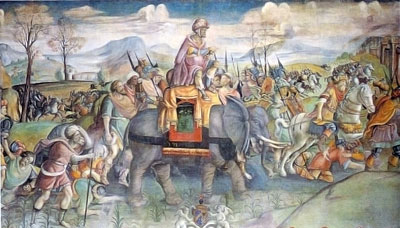
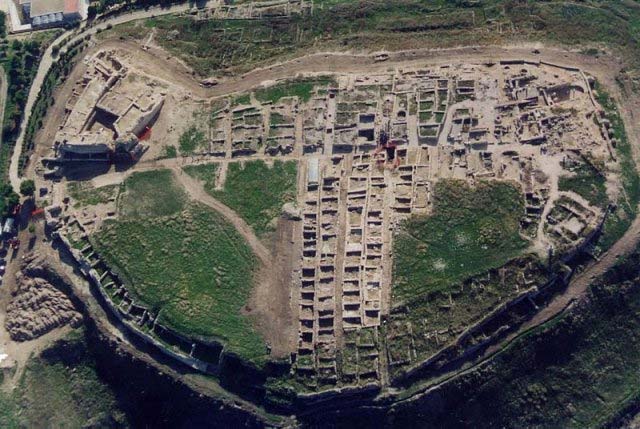
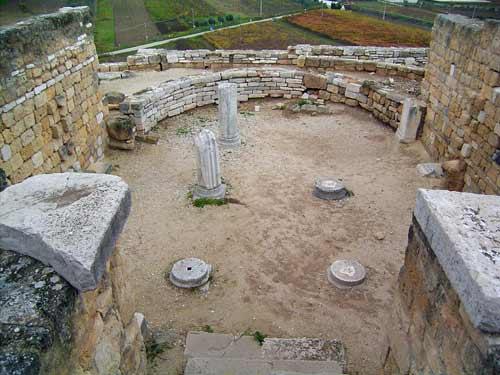

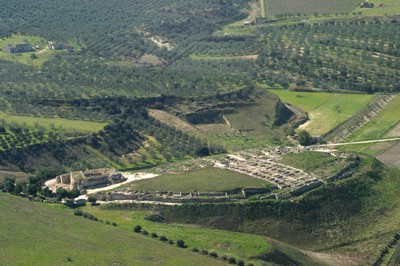
As the armies advanced on one another, Hannibal gradually extended the center of his line, as Polybius describes: "After thus drawing up his whole army in a straight line, he took the central companies of Hispanics and Celts and advanced with them, keeping the rest of them in contact with these companies, but gradually falling off, so as to produce a crescent-shaped formation, the line of the flanking companies growing thinner as it was prolonged, his object being to employ the Africans as a reserve force and to begin the action with the Hispanics and Celts." Polybius describes the weak Carthaginian center as deployed in a crescent, curving out toward the Romans in the middle with the African troops on their flanks in echelon formation.
It is believed that the purpose of this formation was to break the forward momentum of the Roman infantry, and delay its advance before other developments allowed Hannibal to deploy his African infantry most effectively. That being said, while the majority of historians feel that Hannibal's action was deliberate, there are those that have called this account fanciful, and claim that the actions of the day represent either the natural curvature that occurs when a broad front of infantry marches forward, or the bending back of the Carthaginian center from the shock action of meeting the heavily massed Roman center.
Destruction of the Roman army When the battle was joined, the cavalry engaged in a fierce exchange on the flanks. Polybius describes the Hispanic and Celtic horse dismounting in what he considers a barbarian method of fighting. When the Hispanic and Gauls got the upper hand, they cut down the Roman cavalry without giving quarter. On the other flank the Numidians had engaged in a way that merely kept the Roman ally cavalry occupied. When the victorious Hispanic and Gallic cavalry came up, the allied cavalry broke and the Numidians pursued them off the field. While the Carthaginians were in the process of defeating the Roman cavalry, the mass of infantry on both sides advanced towards each other in the center of the field. As the Romans advanced, the wind from the East blew dust in their faces and obscured their vision. While the wind itself was not a major factor, the dust that both armies created would have been potentially debilitating to sight.
Although the dust made sight difficult, troops would still have been able to see others in the vicinity. The dust, however, was not the only psychological factor involved in battle. Because of the somewhat distant battle location both sides were forced to fight on little sleep. The Romans faced another disadvantage caused by lack of proper hydration due to Hannibal's attack on the Roman encampment during the previous day. Furthermore, the massive number of troops would have led to an overwhelming amount of background noise.
All of these psychological factors made battle especially difficult for the infantrymen. Hannibal stood with his men in the weak center and held them to a controlled retreat. The crescent of Hispanic and Gallic troops buckled inwards as they gradually withdrew. Knowing the superiority of the Roman infantry, Hannibal had instructed his infantry to withdraw deliberately, thus creating an even tighter semicircle around the attacking Roman forces. By doing so, he had turned the strength of the Roman infantry into a weakness. Furthermore, while the front ranks were gradually advancing, the bulk of the Roman troops began to lose their cohesion, as they began crowding themselves into the growing gap. Soon they were compacted together so closely that they had little space to wield their weapons. In pressing so far forward in their desire to destroy the retreating and collapsing line of Hispanic and Gallic troops, the Romans had ignored (possibly due to the dust previously mentioned) the African troops that stood uncommitted on the projecting ends of this now reversed-crescent.
This also gave the Carthaginian cavalry time to drive the Roman cavalry off on both flanks and attack the Roman center in the rear. The Roman infantry, now stripped of both its flanks, formed a wedge that drove deeper and deeper into the Carthaginian semicircle, driving itself into an alley that was formed by the African Infantry stationed on the wings.
At this decisive point, Hannibal ordered his African Infantry to turn inwards and advance against the Roman flanks, creating an encirclement of the Roman infantry in one of the earliest known examples of the pincer movement. When the Carthaginian cavalry attacked the Romans in the rear, and the African flanking echelons had assailed them on their right and left, the advance of the Roman infantry was brought to an abrupt halt. The trapped Romans were enclosed in a pocket with no means of escape.
The Carthaginians created a wall and began destroying the entrapped Romans. Polybius claims that, "as their outer ranks were continually cut down, and the survivors forced to pull back and huddle together, they were finally all killed where they stood." As Livy describes, "So many thousands of Romans were dying ... Some, whom their wounds, pinched by the morning cold, had roused, as they were rising up, covered with blood, from the midst of the heaps of slain, were overpowered by the enemy. Some were found with their heads plunged into the earth, which they had excavated; having thus, as it appeared, made pits for themselves, and having suffocated themselves."Cowley claims that nearly six hundred legionaries were slaughtered each minute until darkness brought an end to the bloodletting. Only 14,000 Roman troops managed to escape, most of whom had cut their way through to the nearby town of Canusium. [edit]Casualties [edit]Roman and allied The Death of Aemilius Paulus by John Trumbull, 1773 Polybius writes that of the Roman and allied infantry, 70,000 were killed, 10,000 captured, and "perhaps" 3,000 survived. He also reports that of the 6,000 Roman and allied cavalry, only 370 survived.
Livy writes "it is said that 45,500 foot soldiers and 2,700 horsemen were slain in almost equal proportion of citizens and allies". He also reports that 3,000 Roman and allied infantry and 1,500 Roman and allied cavalry were taken prisoner by the Carthaginians.
Although Livy does not cite his source by name, it is likely to have been Quintus Fabius Pictor, a Roman historian who fought in and wrote on the Second Punic War. It is Pictor whom Livy names when reporting the casualties at the Battle of Trebia.
In addition to the consul Paullus, Livy goes on to record that among the dead were 2 quaestors, 29 of the 48 military tribunes (some of consular rank, including the consul of the previous year, Gnaeus Servilius Geminus, and the former Master of the Horse, Marcus Minucius Rufus), and 80 "senators or men who had held offices which would have given them the right to be elected to the Senate".[34] Later Roman (and Greco-Roman) historians all largely follow Livy's figures. Appian gives 50,000 killed and "a great many" taken prisoner.[35] Plutarch agrees, "50,000 Romans fell in that battle... 4,000 were taken alive". Quintilian: "60,000 men were slain by Hannibal at Cannae". Eutropius: "20 officers of consular and praetorian rank, 30 senators, and 300 others of noble descent, were taken or slain, as well as 40,000 foot-soldiers, and 3,500 horse".
Most modern historians, while rejecting Polybius' figure as flawed, are willing to accept Livy's figure. Some more recent historians have come up with far lower estimates. Cantalupi proposed Roman losses of 10,500 to 16,000.
Samuels also regards Livy's figure as far too high, on the grounds that the cavalry would have been inadequate to prevent the Roman infantry escaping to the rear. He doubts that Hannibal even wanted a high death toll, as much of the army consisted of Italians whom Hannibal hoped to win as allies in the future.

Offers
Who is online
We have 65 guests and 0 users online.
the greater flamingos
-
 The flamingos belong to one of the oldest Order...
 -
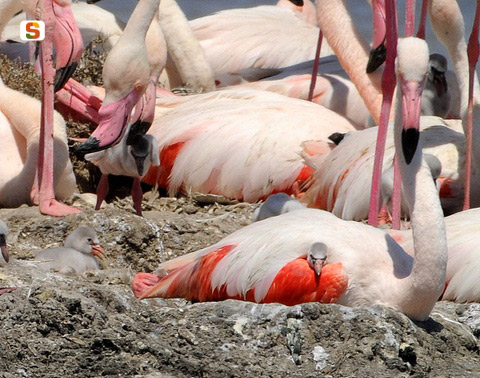 Flamingos only nidificate in rather big colonie...
 -
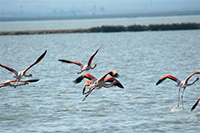 The greater flamingos chiefly occur in lagoons ...
 -
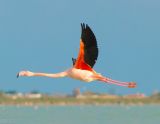 The colour of the feathers of flamingos is due ...
 -
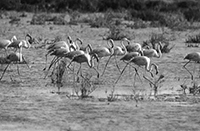 The diet of flamingos is mainly made up of aqua...
 -
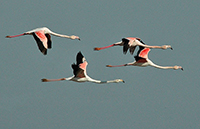 Flamingos are no doubt more famous for their be...
 -
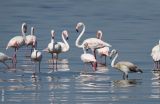 Men have always thought of flamingos as somethi...
 -
 But the most serious threat to the flamingo is ...
 -
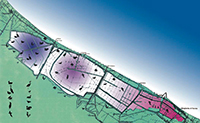 In 1977 the salt-pans of Margherita di Savoia b...
The Wetland
-
In the flat heart of Daunia, on the border between the provinces of Foggia an...
-
 The Ramsar Convention (The Convention on Wetlands of International Importance...
 -
 In Apulia wetlands, vegetation has needed to adapt itself to the peculiar env...
 -
 Apulia offers some of the most significant examples of coastal wetlands. Part...
 -
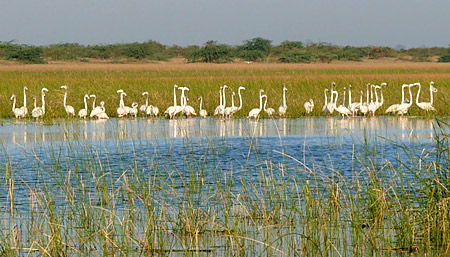 Wetlands are those natural or artificial areas with presence of water, whethe...
The City
-
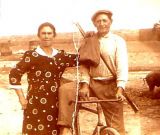 from the book 'Paese Mio' by Emanuele A...
 -
 sono terreni nati a seguito della bonifica dell...
 -
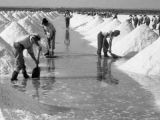 The return of the inhabitants to the original t...
 -
 main numbers of general interest
 -
 Margherita di Savoia Spa stands on a vast area ...
 -
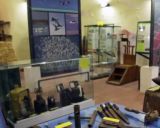 Located in Margherita di Savoia in Corso Vittor...
 -
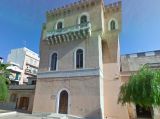 Seat of the municipal art gallery
 -
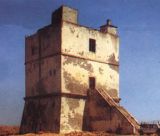 going north of Margherita di Savoia, on the mai...
The Saltpan
-
 The saltpan stretches on a strip of land approximately 20...
 -
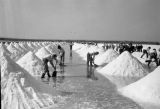 La storia di Margherita di Savoia vive da sempre in perfe...
 -
 Le paludi sono ambienti di notevole interesse naturalisti...
 -
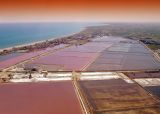 In ancient times here was Lake Salpi, a coastal basin wit...
 -
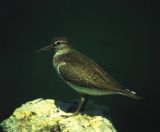 la fauna è spiccatamente ornitica, anche se non è da tras...