



 0883.656676
The City
-
About 90 cm long, its plumage is grey on the ba...
-
About 40 cm long, it has very long legs and fou...
-
The Eurasian Curlew, or in Europe just Curlew, ...
-
The mallard is about 20-28 inches in length and...
-
The Glossy Ibis, Plegadis falcinellus is a wadi...
-
Ordine anseriformi, famiglia anatidi. Specie pa...
-
The adult Little Egret is 55–65 cm long with an...

The mallard is about 20-28 inches in length and has a wingspan of about three feet. It has a blue patch on the top side of its wings with a white line around it.
The male mallard has a green head and neck with a white ring bordering it. It has a brown chest, a whitish-gray underside, brown wings and a yellow bill. The female mallard is mottled brown and tan with a white tail and an orange bill.
Range
The mallard breeds in most of Canada and the United States. It winters throughout the United States and south to Central America and the West Indies. The mallard can also be found in Europe and Asia.
Habitat
The mallard lives in marshes, lakes, swamps, rivers, streams and ponds.
Diet
Most of the mallard's diet is made up of plants. It eats the seeds of grasses and sedges and the leaves, stems, and seeds of aquatic plants. It occasionally eats insects and crustaceans and mollusks, especially when it is young. It prefers to forage in water that is less than 16 inches deep so it can duck its head down and reach plants at the bottom. The mallard sometimes forages on farmland for grains like rice, corn, oats, wheat, and barley.
Mallard courtship begins in the fall and by winter pairs will have formed. If a pair is part of a migrating group, the pair migrates to the female's territory. The female mallard lays eight to ten eggs in a nest on the ground. Nests are depressions in the ground and are usually no further than 100 yards from water. The nest is lined with down and is usually hidden in tall grass.
The eggs take about a month to hatch. The female incubates the eggs. The male will leave once incubation has begun. Within a day of hatching, the mother leads the chicks to water for their first swim. The chicks fledge when they are about eight weeks old.
Behavior
After the mating season is over, some mallards in colder climates migrate in flocks to their wintering grounds. Other mallards in warmer areas where there is plenty of food will stay year-round.
The mallard is the ancestor of almost all breeds of domestic ducks. It breeds with feral domestic ducks. The offspring of these mismatched pairs exhibit a wide-variety of color patterns. The mallard also mates with other duck species like the American black duck and the northern pintail. In fact, there is some concern that the black duck species is in danger from hybridization with the mallard.

Offers

Who is online
We have 33 guests and 0 users online.
the greater flamingos
-
 The flamingos belong to one of the oldest Order...
 -
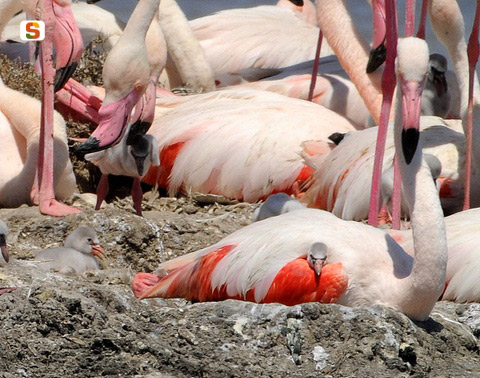 Flamingos only nidificate in rather big colonie...
 -
 The greater flamingos chiefly occur in lagoons ...
 -
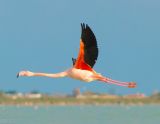 The colour of the feathers of flamingos is due ...
 -
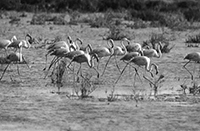 The diet of flamingos is mainly made up of aqua...
 -
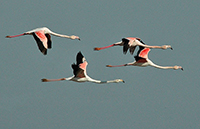 Flamingos are no doubt more famous for their be...
 -
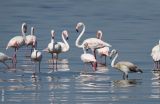 Men have always thought of flamingos as somethi...
 -
 But the most serious threat to the flamingo is ...
 -
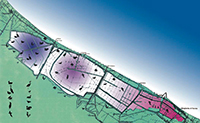 In 1977 the salt-pans of Margherita di Savoia b...
The Wetland
-
In the flat heart of Daunia, on the border between the provinces of Foggia an...
-
 The Ramsar Convention (The Convention on Wetlands of International Importance...
 -
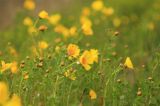 In Apulia wetlands, vegetation has needed to adapt itself to the peculiar env...
 -
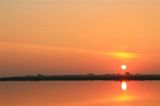 Apulia offers some of the most significant examples of coastal wetlands. Part...
 -
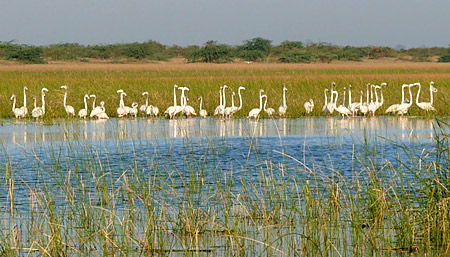 Wetlands are those natural or artificial areas with presence of water, whethe...
The City
-
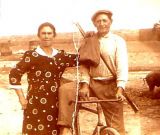 from the book 'Paese Mio' by Emanuele A...
 -
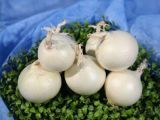 sono terreni nati a seguito della bonifica dell...
 -
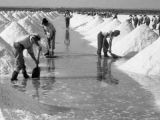 The return of the inhabitants to the original t...
 -
 main numbers of general interest
 -
 Margherita di Savoia Spa stands on a vast area ...
 -
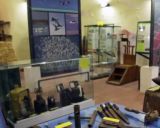 Located in Margherita di Savoia in Corso Vittor...
 -
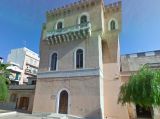 Seat of the municipal art gallery
 -
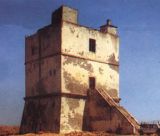 going north of Margherita di Savoia, on the mai...
The Saltpan
-
 The saltpan stretches on a strip of land approximately 20...
 -
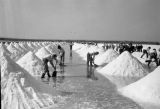 La storia di Margherita di Savoia vive da sempre in perfe...
 -
 Le paludi sono ambienti di notevole interesse naturalisti...
 -
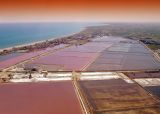 In ancient times here was Lake Salpi, a coastal basin wit...
 -
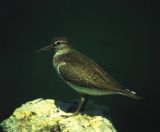 la fauna è spiccatamente ornitica, anche se non è da tras...